

Ēostre
Uncovering embodied wisdom through the shrouded Goddess

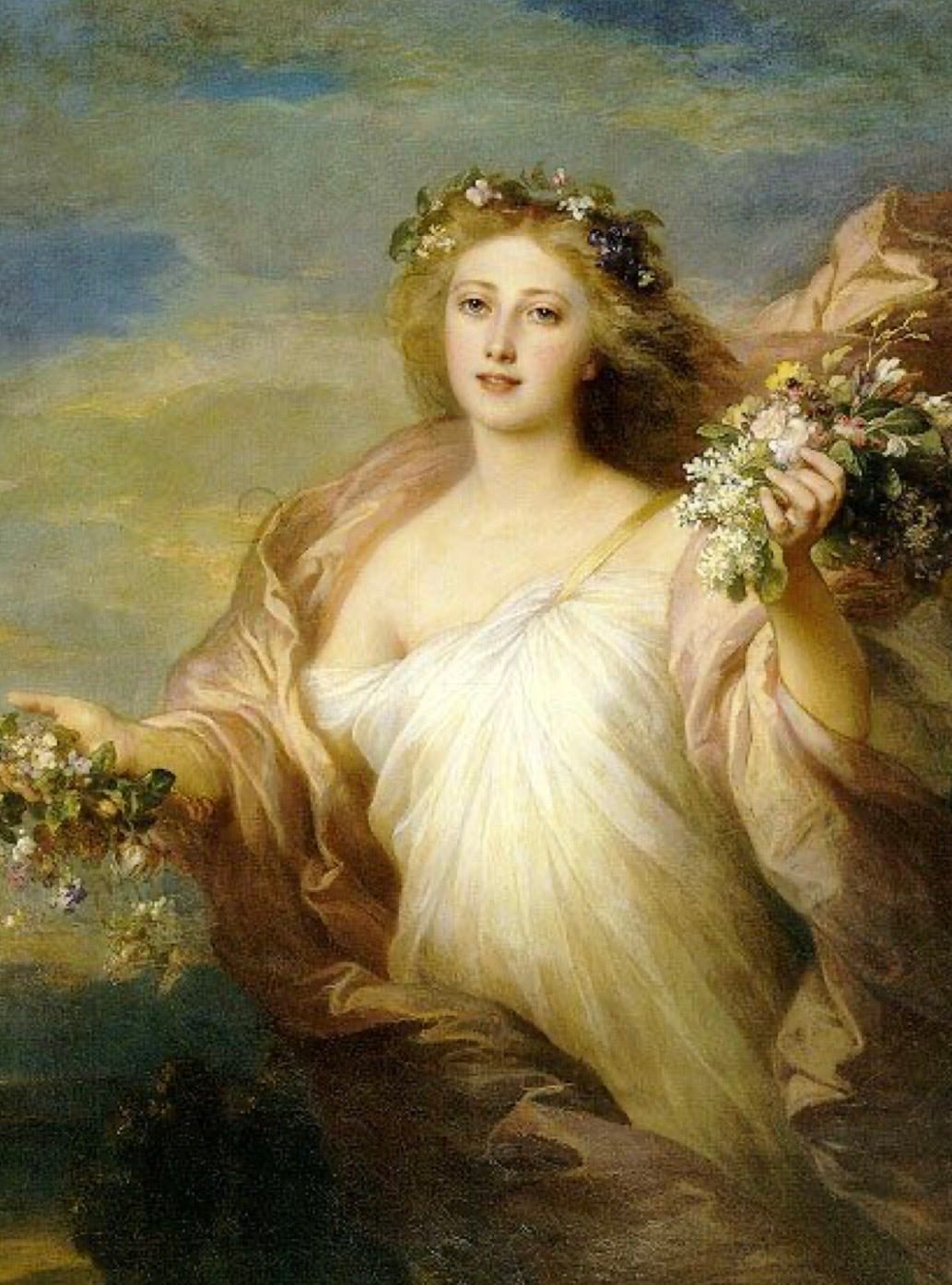
Who was this figure so shrouded in mystery yet held in such a high esteem her name would used for the most prominent of church celebrations?
In modern times you’ll hear her as the goddess of renewal and birth. But she goes beyond that.
The original tender of thresholds— the Goddess Eostre. So beyond time and space that very little has been recorded of her. The earliest mention of her comes not even by her name, but a month enveloping Her. This comes from an English Christian monk, Bede, from the eighth century. In his book, The Reckoning of Time, he speaks about the origins of months’ names in the Anglo-Saxon lunar calendar. April was associated with Eosturmonath. In the eighth century this was “translated to ‘Paschal month’ (Easter Month) and which was once called after a goddess of theirs named Eostre, in whose honour feasts were celebrated in that month. Now they designate that paschal season by her name, calling the joys of the new rite by the time-honoured name of the old observance.” (Excerpt pulled from The Reckoning of Time.)
This presents us with the great mystery surrounding Eostre. Prior to Bede’s exploration and recorded observations we had no peaks into this aspect of our deep history.
Does this record speak to a primordial feminine energy?
Much of history and local traditions of this time were passed down orally. The goddess of thresholds and mystery wouldn’t have been a recorded deity but rather a reality of life.
What caught my attention the most in this excerpt was that the paschal season was designated to Her– feasts held in Her honor, traditional ceremonies carried through to modern time.
It wasn’t until the 1800s that she resurfaced and gained popularity thanks to folklorist Jacob Grimm. In his book on German Mythology, he believed that the goddess Bede was speaking of must have had older facades, one which he named Ostara.
“Eostre seems therefore to have been the divinity of the radiant dawn, of upspringing light, a spectacle that brings joy and blessing, whose meaning could be easily adapted by the resurrection-day of the Christian’s God. This Ostara, like the [Anglo-Saxon] Eostre, must in heathen religion have donated a higher being, whose worship was so firmly rooted, that the Christian teachers tolerated the name, and applied it to one of their own grandest anniversaries.” (Excerpt from Deutsche Mythologie, Grimm.)
Could Eostre be yet another example of the divine feminine hidden within the trojan horse of Christian religion? Who was this Goddess so deeply rooted in the local tradition that Christian monks had no choice but to tolerate her name and reverence?
As with many of the primordial mother goddesses we must reverse construct modern ceremonies to find their roots within ancient history. A goddess of such importance her name memorialized for thousands of years in the ritual’s title. Is it possible to reconstruct her observance using ancient Germanic spring customs, folk traditions and seasonal patterns?
Because direct evidence for Eostre’s worship is limited to Bede, her ritual observances can only be reconstructed through comparison of linguistic roots, seasonal timing, historical parallels, and early Christian replacement patterns to make some guesses as to how Eostre’s celebration would have played out.
The biggest obstacle is a problem of sources. Our only primary reference of Eostre comes from Bede’s work De Temporum Ratione, published in 725 CE. In this he tells us three things: the month of April was named after Eostre, a feast existed, Christians replaced it but kept the name. While no details of her observation are noted, we could make an assumption that for local peoples she was a primary deity. It was frequency Christina monks would rename celebrations, changing them just slightly to usher in the pagan folk. More on that in a bit. But for now, we’re left with very little substance to reconstruct what an original celebration would have looked like.
Time and Cosmology of Eostre
We pull first from the anchors we do have, time and cosmology. We know that Her celebration occurred in April, Eosturmonap. As has stayed true in modern times, April comes at the heels of the vernal equinox and begins near the first full moon of spring. This is the same system that will later be used for Easter. The Sunday after the first full moon following the spring equinox. So we already see more evidence of her power of continuity, but what were her core qualities?
With April being the first full month of spring we look to spring as an archetype. Spring is a threshold moment. A time when light overtakes dark and we see the earth become fertile again. Celebrations during this time would center on themes of transition, emergence and renewal. Any deity would have held one, or all, of those qualities. To have one’s name used as the title of the celebration would mean a great deal more.
Function of the Goddess
Our next piece of solid evidence is her name, Eostre. The root meaning to her word translates to “dawn” or “to shine”. It’s related most to the East, as the direction of the sunrise. We have similar root words in Aurora-type deities. Eos and Aurora come from Greek and Roman traditions respectively. Both Goddesses of rebirth and the fragile beauty of new beginnings. Interestingly, neither had major temples but were honored through daily life in poems, prayers, and devotional observance as bringer of renewal and the inspiration for the new day.
Comparing Eostre to these other name roots we can begin to understand her as that of a dawn or threshold goddess. Symbols associated with Her would be: returning light, cyclical renewal and awakening.
Her Presence in Daily Life
But how did Eostre fit into the bigger picture of daily life? To examine this we look across other Indo-European cultures and their spring festivals. To no surprise we find many shared ritual elements of those of our deep past. We see elements of fire or light rituals, symbols of fertility, offerings to the land, and processions or outdoor gatherings. We can assume that the celebration of Eostre during this time would mirror the same.
Using Eos and Aurora as foundation models for Eostre we could see similar models for worship as with the later. Daily worship was given to these older models through the small joy of a sunrise and rebirth of a new day; through poems or devotional prayers one crafts, as they do, to greet the new day. I think we’re getting somewhere now.
Christian Overlay as Clue
We see several ways in which Christianity had overlaid much of these traditional celebrations of the time. Through name, time, season and theme. The Chrisitian rituals mirrored the structure but replaced the meaning. These practices of Easter included practices such as sunrise vigil, candle lighting, baptism (rebirth), and a shared feast. For example, the practice of an Easter Vigil (night to dawn) mirrors a likely earlier pattern of welcoming dawn. We see this repeated with Paschal candle and fire rituals of earlier times. Themes of rebirth and feast are present in both the old and Christian reclaiming. The structure of Easter liturgy may persevere the ritual shape of earlier seasonal observances, even as its theology differs. Using these we begin to build out foundational elements to our reconstruction.
Folk Survivals
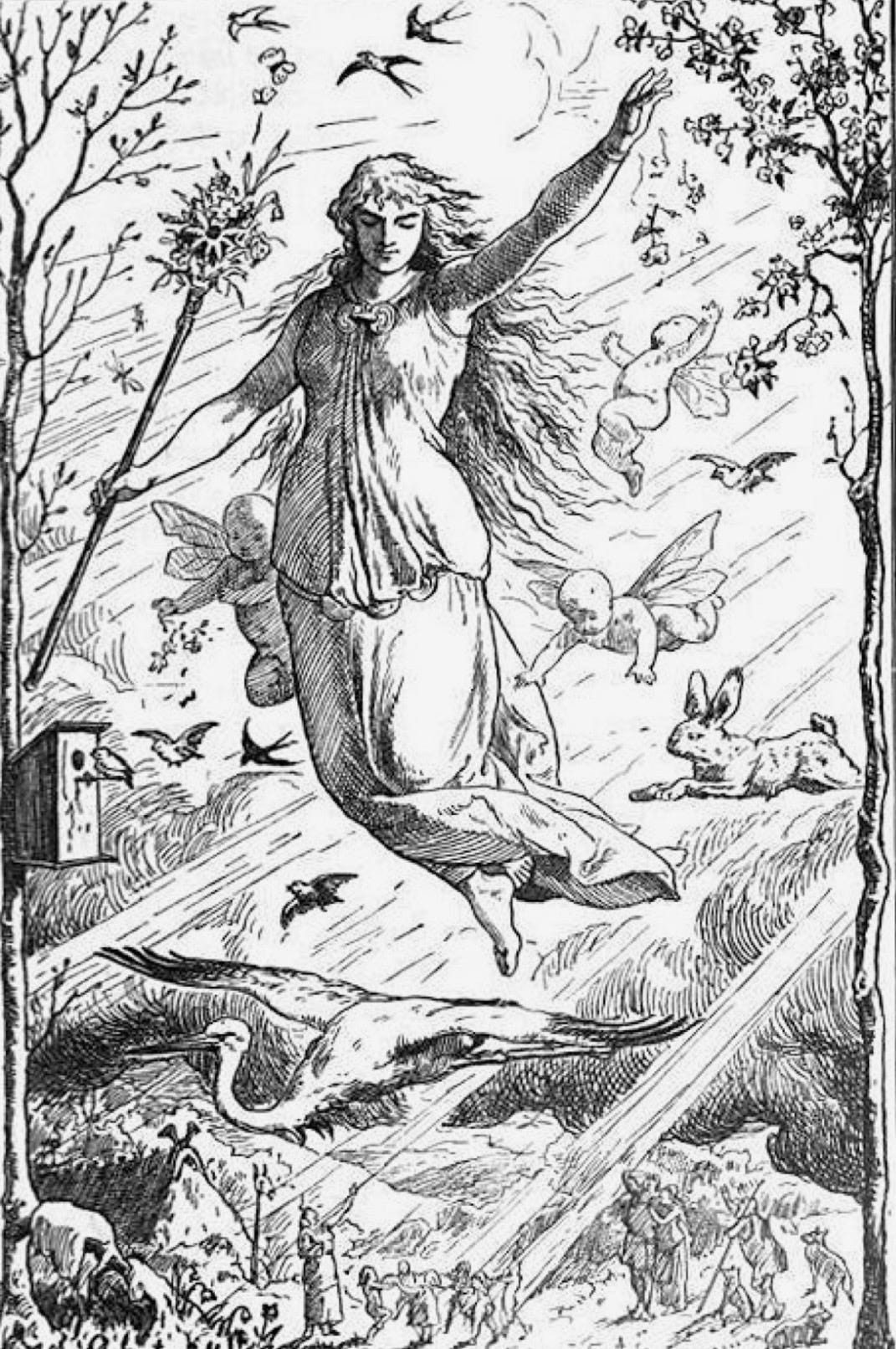
Later traditions carried Eostre from the works of 8th century monk into the public sphere through Mr. Grimm. In his German Mythology book he reclaims the Goddess in his own image of the spring maiden, Ostara. This is a name you’re probably much familiar with in seasonal celebrations. This is also when I urge you to adopt Eostre as more historically accurate, even though shrouded in mystery.
I digress. With this revamping of Eostre’s image comes new traditions. While they have no direct connection to Eostre, they are modern motifs that have stuck for the past several hundred years. They speak to a broader symbolic system of Spring and Easter. Those are: eggs, hares, and spring games or feasts. They do speak to some cultural continuity. Not of a thing that’s recorded but a felt experience. Something embodied deep within the human body.
As a chicken owner myself I know exactly the joy that’s felt when eggs start flowing again. It’s like gold. And I have access to them at Aldi. For someone pre-industrial a steady supply of eggs could mean the difference between starvation and survival in the early spring days.
The symbol of the hare is one of fertility and liminality. Fertile in their nature to reproduce prolifically and with little distress. We see them run quickly across forest paths seeking a proper mate for their next litter. Hares also bear the symbol of rebirth. There is connection to hares being deeply connected to the earth and its mystical, regenerative ability. They exist in both the day and nocturnal patterns, a being beyond thresholds.
While these symbols are more modern and could be of cultural insertion, I choose to believe it runs deeper– to an encoded, embodied memory.
Eostre Celebration
With linguistic analysis, seasonal timing, historical parallels and Christian replacement patterns we can recreate a plausible celebration for Eostre.
It would have begun with a pre-dawn gathering. Together the community would come together and face east. Together in darkness awaiting the break of dawn.
With the first ray of sun they would have lit a fire central to the group. Sharing in the deep symbol of returning life and power of dawn.
Next the wise woman of the community would invoke the goddess. Honoring Eostre as bringer of dawn and renewal through poems, songs or chanting.
Once invoked, they would have asked for blessings on their fields, their seeds, and their animals for the growing season ahead. Possibly ask for fertility blessings to peoples of the community.
Offerings would be made to the Goddess, the land and the spirits involved, showing a reciprocal nature to their relationship.
The close the celebration the community would have shared in a great feast. A marked end to the scarcity of winter is celebrated through the returned abundance of spring greens and new life.
Embodied Memory
Though Eostre herself remains elusive, the seasonal, linguistic and ritual patterns surrounding her suggest a festival centered on dawn, renewal, and the reanimation of the land. Earthly Christian EAster, rather than preserving her rites directly, appears to have occupied the same temporal and symbolic space, burying the wisdom deep within the body to resurface in a time of safety as embodied memory.
The time for awakening and dawn is now. The goddess Eostre is there to walk us through the threshold.

Ritual
Any ritual to the goddess of dawn would occur at dawn. With that in mind, gather your materials and set up what you can the night before.
Gather
-Fire source (candles or fire pit if outside)
-Early spring flowers
-Journal and pen
-White dress or robe
-Prep tea or warm bev for chilly mornings
-Fresh or moon water
-Small bowl
-Offering (bread, honey, wine, flowers, oatmeal, etc.)
Set up
-Altar space. Set the altar space the night before with light colored table cloth and items that embody spring. Set any candles you wish to use. Ensure that the altar has you seated facing the east.
-Prep tea or coffee for ease. You’ll thank me later!
-Small basket of your gathered belongings.
Optional:
Write up a short poem or invocation to the Eostre. If you’re not feeling inspired to do so, I’ve got one below.
Wake before sunrise, before the earliest shift in the sky (this is often 30-60 minutes prior to actual sunrise), to prepare. Dress in something white and flowy to create a sense of liminalailty. This isn’t a typical morning but a morning of rebirth.
With your basket of gathered things you set out to your altar.
Place your bowl, water, tea, journal and offerings on top of the altar surface. Fill your bowl with the intention that the water will absorb the morning light.
Sit in this liminal space between night and day, light and dark.
Take in the sounds around you.
Notice birds, early to sing, up before the first sign of daybreak, loud with their song.
While in this dark, stillness, allow yourself to imagine what is still dormant within you. Are there any aspects that wish to awaken? Any desires or patterns coming into the light?
Allow yourself space to be present and allow for any insight or significant happenings to find you.
With the first break of dawn, light your candles. Feel the first ray meet your face in warmth that radiates down into your heart. Feel it fill your heart and vessel with love.
In the embrace of dawn’s light cleanse your face in preparation of the journey ahead.
Eostre
Esotre
Welcome thee
Bringer of dawn awaken me
I call upon you
This time-honored morning
For your guidance
Be with me
This moment
This place
This time
I welcome your presence now.
Feel the presence of Eostre.
For me, it’s like a rush of energy straight through the heart. The joy and freedom of a new day. The relief of light after darkness. To me, it’s a powerful difference but I’d love to know how She lands within you.
With Eostre present you request her guidance in the crossing of your own thresholds– into your own moment of rebirth. Allow her to offer insight through the senses. Even if it feels imaginary, allow it to come through. Ask for guidance in the next step
Remember, she is the dawn of a new day, everyday. She shows up tirelessly for us humans. There are no tasks she can not assist with.
Once you’ve made your request. Once you obtain instruction. Place a portion of your offering onto the altar for Her.
At this time, if there is any blessing you wish to obtain you may do so. Use caution and only do so if it feels proper. This is not to induce fear but to build a reciprocal relationship with the deity. Some blessings that fit this interaction are for one’s garden, fertility journey, rebirth, or new project.
Once you feel complete, offer the rest of your offering to the land around you. Whether we are aware of it or not, nature spirits are frequently coinciding to support our ventures when they align with similar values and outcomes (garden blessings would greatly support any nature spirits in your space).
Now take your bowl of dawn charged water. Hold it and set the intention for cleansing, blessing, beauty, or any other requests that come to your heart.
Allow the water to renew your spirit. Mark this as the moment of change.
Allow yourself to bask in the early morning light. Enjoy your drink. Settle in and feel the rebirth happening within you.
Closing Thoughts
Esotre is an aspect of the divine worthy our attention at this time– bringer of dawn and awakening. Not in the superficial but in the real tangible things. Things such as the Earth and Her greening, the revitalization of a new day, the beauty of community and shared celebration. All of that is, at its root, the christian celebration of Easter today. After learning more of her history and deep connection within daily life of Greek and Roman peoples it’s clear we are uncovering an aspect of the feminine long shrouded. There’s a deeper awakening that comes from seeking insight into these figures of deep history that awaken something within us long dormant. Embodied truth shines through.
From runic studies I see it as relating to the rune Kenaz, fire of knowledge– a flame carried in the undercurrents of humanity until someone in the line is ready to take and carry the torch forward. I see the dawn of Eostre as a passing of the torch. A reclaimed knowledge of something much older than our present day Gods.
Eostre echoes to a goddess that was so coded in daily life she was welcomed daily. The breaking of dawn has always instilled us with warmth, hope, renewal, and joy. A shared human experience of bliss. A continuity across time and space– a welcomed dawn. In this way we can then see that Eostre, while revered with gratitude daily, was honored this month/weekend of all– the revival of life upon Earth, given by Her blessing of light.
I plan to work with her daily throughout April and see what other embodied knowing can be extracted. I’ll share that to my paid subscribers.
I’d love to know how this article lands with you. Do you too feel the call to connect more deeply with old feminine figures of our past?
Eostre (Easter) has taken on a whole new meaning for us this year. I look forward to Her celebration.
Thank you so deeply for being here.
Taylor
this was such a wonderful read!!